
This text was incredibly dense – encompassing physics, mathematics, linguistics, philosophy ( rather , philology ), biology ( conceptual biology?), computer science and what I would describe as ‘phenomonology of reader’. McGann moves through persons, sciences, theories, languages and disciplines like a current of water against a jetty : with full force and without a diminishment in momentum. The text was hard to orientate myself within ( which seems by design) so I’m not certain where to begin. I’m not certain of what I comprehended. And I’m suspicious that that may have been McGann’s intention.
McGann mentions briefly Roland Barthes, which helped me to anchor myself in the text. I’ve never studied literature, so the concepts and logic running through the text were new and difficult. Roland Barthes’ essay The Death of the Author is an important text in Contemporary Art History ( my area of competence), and allowed me to get a sense of McGann’s conceptualisation of the ‘text’. Sacrificing nuance for pith : Barthes held that the text was independent of the author, and that the act of reading was essentially a creative one, one of ‘meaning making’.
So, what is ‘text’, or at least printed text?
Print and manuscript technology represent efforts to mark natural language so that it can be preserved and transmitted. It is a technology that constrains the shapeshiftings of language, which is itself a special-purpose system for coding human communication.[efn_note] Schreibman, Susan, Ray Siemens, and John Unsworth. 2004. Companion to Digital Humanities (Blackwell Companions to Literature and Culture). Hardcover. Blackwell Companions to Literature and Culture. Oxford: Blackwell Publishing Professional. http://www.digitalhumanities.org/companion/. [/efn_note]
If my interpretation is correct, ‘text’ is an attempt to codify language so as to be universally comprehensible, able to disseminated, archived and is searchable.
McGann argues that this codification is delimiting, or perhaps the word I’m looking for is quantifying. There is also the quality of index to indexical. That it is only representative of the thing itself.
Textualized documents restrict and modify, for various kinds of reflexive purposes, the larger semeiotic field in which they participate.[efn_note] Schreibman, Susan, Ray Siemens, and John Unsworth. 2004. Companion to Digital Humanities (Blackwell Companions to Literature and Culture). Hardcover. Blackwell Companions to Literature and Culture. Oxford: Blackwell Publishing Professional. http://www.digitalhumanities.org/companion/. [/efn_note]
Because “coding … represents the interactions of [an] observer” with a given system, the mapping stands apart from “the observed domain” (Maturana and Varela 1980 (Links to an external site.): 135). Coding is a function of “the space of human design” operations, or what is classically called “hetero-poietic” space. Positioned thus, coding and markup appear allopoietic.[efn_note] Schreibman, Susan, Ray Siemens, and John Unsworth. 2004. Companion to Digital Humanities (Blackwell Companions to Literature and Culture). Hardcover. Blackwell Companions to Literature and Culture. Oxford: Blackwell Publishing Professional. http://www.digitalhumanities.org/companion/. [/efn_note]
McGann’s thinking here is very much in line with the William Blake quotation he uses as an epigraph
Bring out number weight & measure in a year of death.
As with the Barthes reference, this helped anchor myself in McGann’s logic through my own discipline. This Blake print depicting Isaac Newton came to mind.
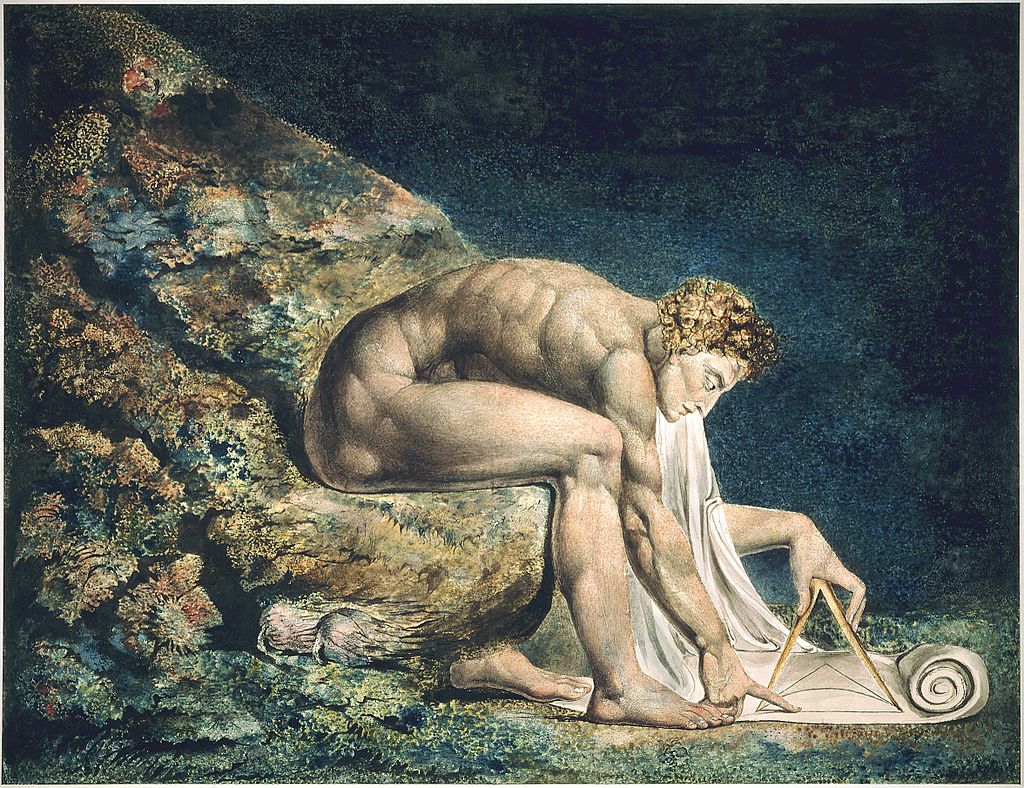
This work doesn’t celebrate Newton, it denounces him. Blake saw the systems of measurement of science, the great compass, as delimiting . That it was a rigid constraint on spirituality and vision. It was the antithesis of creativity.
I must create a system, or be enslaved by another man’s. I will not reason and compare: my business is to create.[efn_note] Blake, William, Jerusalem. The Emanation of the Giant Albion, Plate 10 , Line 20. http://erdman.blakearchive.org/#jerusalem [/efn_note]
What exactly is McGann’s point?
No autopoietic process or form can be simulated under the horizon of a structural model like SGML, not even topic maps. We see this very clearly when we observe the inability of a derivative model like TEI to render the forms and functions of traditional textual documents. The latter, which deploy markup codes themselves, supply us with simulations of language as well as of many other kinds of semeiotic processes, as Peirce called them. Textualized documents restrict and modify, for various kinds of reflexive purposes, the larger semeiotic field in which they participate. Nonetheless, the procedural constraints that traditional textualities lay upon the larger semeiotic field that they model and simulate are far more pragmatic, in a full Peircean sense, than the electronic models that we are currently deploying.[efn_note] Schreibman, Susan, Ray Siemens, and John Unsworth. 2004. Companion to Digital Humanities (Blackwell Companions to Literature and Culture). Hardcover. Blackwell Companions to Literature and Culture. Oxford: Blackwell Publishing Professional. http://www.digitalhumanities.org/companion/. [/efn_note]
The Ivanhoe Project ( now defuncted) that appears in the text was an attempt at an autopoietic mark up system, with a complex interaction between text and reader/editior/player/character rather than
SGML and its derivatives [that] freeze (rather than integrate) the function spaces of discourse fields by reducing the field components to abstract forms[efn_note] Schreibman, Susan, Ray Siemens, and John Unsworth. 2004. Companion to Digital Humanities (Blackwell Companions to Literature and Culture). Hardcover. Blackwell Companions to Literature and Culture. Oxford: Blackwell Publishing Professional. http://www.digitalhumanities.org/companion/. [/efn_note]
I’m still left thinking, what does McGann want? Does he want Homer to sing The Iliad to us? Does he view TEI as too perfunctory? That the nature of mark up leads to the neutering of words, of language, of meaning through sytemisation and standardisation? Does he view the Ivanhoe Project as the next step in ‘text’?
McGann is playing with the concepts he describes and denounces in this text, like a conceptual art work. McGann’s appendix on the ‘pataphysics of text and mark-up seems almost like the great reveal. This article gives some sense to the term, and more so the attitude with which it is used.
https://www.theguardian.com/culture/2005/dec/09/8
I’m left much better informed on the question of ‘text’, but uncertain of McGann’s purpose beyond a grand experiment in text.
Image : William Blake Newton (1795–1805) 460 x 600 mm. Collection Tate Britain. Sourced from http://www.blakearchive.org/