
In 1998 the estate of the artist Francis Bacon ( 1909-1992) donated the contents of the 7 Reece Mews studio used by Bacon from 1961 until his death in 1992 to Dublin City Gallery The Hugh Lane. The entire contents of the studio were catalogued by a team of archaeologists and moved, along with the studio walls and floor, to Dublin City Gallery The Hugh Lane and placed as a permanent exhibition. Among the over 7,000 catalogued items were 646 books . This collection, Donation 1, uses the reference code RM.
In 2001 the books stored by Bacon in the living quarters of 7 Reece Mews and a property in Suffolk, amounting to 723 books, were donated by The Estate of Francis Bacon to Dublin City Gallery The Hugh Lane. This collection, Donation 2, uses the reference code BB
Initiated in 2010, an Irish Research Council for the Humanities and Social Sciences (IRCHSS) funded project titled Bacon’s Books: Francis Bacon’s library and its role in his art had the stated goal to “catalogue the books into a detailed searchable database for visiting researchers, with a list of texts to be made available online…If feasible, the full version of the database will be made accessible on the web.” Further details are linked at www.tcd.ie/History_of_Art/research/triarc/bacon.php
Frustratingly little information is available on the database as described and on The Francis Bacon Studio Database. A symposium held on the role of Bacon’s library on his work was held in October 2012 and appears to be the last public engagement of the Bacon’s Books project. (Link to details at www.hughlane.ie/lectures/lectures-past/674-francis-bacon-symposium) The Francis Bacon Studio Database, a separate but interconnected project, is functioning but is not publicly accessible
The Francis Bacon Studio Database is the first computerised archive of the entire contents of a world ranking artist's studio. Every item in the studio has a database entry. Each entry consists of an image and a factual account of an object. pic.twitter.com/SawePCaTp1
— The Hugh Lane (@TheHughLane) April 12, 2019
Publicly accessible is a CVS document compiled by the project of the bibliographical details of the books. In addition are annotations detailing leaves torn from books, altered by Bacon as part of his working process. I have collated publicly available materials to visualise the Bacon’s Books CVS as a dataset, which when entirely disconnected from its contextual and visual qualities exists as an abstract and disjointed thing .
Donation 2 : Books Found in Dales Farm and 7 Reece Mews Living Quarters
The books of Donation 2 were the personal library of Bacon, as opposed to the sources of imagery and inspiration of Donation 1. Donation 2 is significantly more literary and textual than Donation 1. While there was some migration of books and torn leaves from Bacon’s living spaces to his studio, the reverse wasn’t so. The books of donation 2 were well maintained and free of the signature paint splotches of Donation 1.
Below is a categorised interactive treemap of 642 books from Donation 2. Four books have been removed from the original CVS file, such as British Airways. Worldwide Timetable 1988 (Ref No. BB5.34) to aid in clarity and focus
Interactive Catagorised Treemap of Donation 2 . Photo Credit : The Estate of Francis Bacon.
The categorisations are based on qualitative descriptions to allow for a clearer overview of Bacon’s literary interests. Many of the texts are out of print or not in popular use. The books are often in languages other than English or are simply unclear from the title as to what their subject matter is. This left search engine and database searches on the books a time consuming task. This qualitative description is meant to turn the abstraction of the CVS file into a means to see what subjects occupied Bacon’s mind and influenced his work.
Donation 1 : Books and Torn Leaves Found in Reece Mews Studio
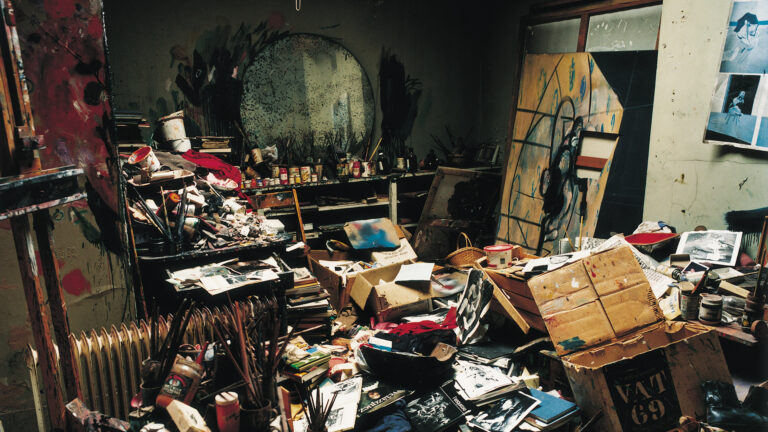
The chaos of Bacon’s studio, with books torn apart and pages scattered across the space was the matrix for Bacon’s imagery. The books of Donation 1 tend to be more esoteric, more visceral. These works were of interest to Bacon for their photographs, illustrations and plates rather than their content.
During his lifetime Bacon was secretive, almost self-conscious about his working process : tearing pages from books, altering them with paint and physical interventions. With the archiving of the materials from the studio, image and textual datasets can be cross referenced to explore the conception of Bacon’s major works. The interactive images below collate data from the Bacon Book’s CVS and JPEGS of archived materials. Please note scroll function for pop-ups.
Three Figures at the Base of a Crucifixion, 1944, Oil on 3 Boards, 94 x 73.7 cm each. Tate Britain, London
Von Schrenck – Notzing, Phenomena of Materialisation , 1929. Ref No. RM98F138:1
Barbara Dawson, director of The Dublin City Gallery Hugh Lane, describes the The Phenomena of Materialisation, as “One of the most curious and revelatory books found in Bacon’s studio.” ( Nori, Dawson, Harrison, 2012) While Bacon was clearly interested in the surreal quality of the images, Bessy’s A Pictorial History of Magic and the Supernatural, 1966 (RM98F138:2B) also found in the studio is thematically similar and replete with illustrations. ( Link to Front Cover on hughlane.ie )
Gruenwald, Atlas-Manuel des Maladies de la Bouche, du Pharynx et des Fosses Nasales, 1903, loose leaf, Ref No. RM98F105:140J
“I’ve always been very moved by the movements of the mouth and the shape of the mouth and the teeth. People say that these have all sorts of sexual implications, and I was always very obsessed by the actual appearance of the mouth and teeth…” — Francis Bacon (Gill, 1966)
Aeschylus, The Oresteia, 1946, Ref No. RM98F201:1
“I tell you what I really read: things which bring up images for me. And I find that this happens very much with the translations of Aeschylus” – Francis Bacon (Sylvester, 2000)
The eponymous three figures are based on the Furies, deities of vengeance, in Aeschylus’ The Oresteia. This association is clearer in Fury, 1944 ( Link to painting). Four books of Aeschylus’ work were found in Donation 2, and three in the studio Donation 1.
Two Figures, 1953, Oil on Canvas, 152.5 x 116.5 cm. Private Collection
Multiple Copies Of Eadweard Muybridge’s The Human Figure In Motion
Five copies of Eadweards Muybridge’s The Human Figure in Motion and hundreds of loose leaves from copies with physical interventions were found in Bacon’s studio. In addition were Eadweard Muybridge: The Stanford Years 1872-1882,1972 ( Ref No : loose leaves: RM98F104:102, RM98F105:134 ) and Eadweard Muybridge. The Man who Invented the Moving Picture, Ref No : RM98F244:5 )
Study after Velázquez’s Portrait of Pope Innocent X, 1953. Oil on canvas, 153cm x 118cm. Des Moines Art Center, De Moines, Iowa.
Screaming Nanny’ Still From Battleship Potemkin.
The close-up shot of the ‘Screaming Nanny’ taken from Sergei Eisenstein’s Battleship Potemkin, 1925, became a reoccurring motif in Bacons’ work, most literally realised in Study for the Nurse in the Film Battleship Potemkin, 1957 ( Link to Painting).
Multiple Catalogues and Catalogue Raisonné of the Works of Diego Velázquez (1599 – 1660)
While Study after Velázquez’s Portrait of Pope Innocent X is the most famous of the major ‘screaming Pope’ works after Diego Velázquez’s Portrait of Pope Innocent X, c.1650, the first painting that utilises this imagery is Landscape With Pope/Dictator, 1946 (Link to painting).
Several of the 15 Velázquez catalogues found are identical copies, with varying numbers of torn pages. The interactive bar chart below details the copies found in both donations and further detail Bacon’s interventions on the books.
“I became obsessed with the painting and I bought photograph after photograph of it.” – Francis Bacon (Sylvester, 1988)
Bar Chart of Chronological Order of Velázquez Catalogues, Editions and Torn Pages
Bacon's Medical Books
Among the books of both donations are thirty one medical text books. Twelve of these, found in the studio, have a focus on illustrating disease and malformity. Bacon’s interest in these are clearly from the uniquely gory, visceral quality of this kind of illustration and photography.
In contrast to the injury and disease detail of the medical books found in the studio, the books of donation 2, the living spaces, are generally for self-care and aging. There is a particular increase in these books from the 1980s when Bacon was in his seventies and in ailing health. Even superficially, when viewing the front covers of the books, the books of Donation 1 and Donation 2 are in contrast. This can be viewed in the carousel below.
Carousel of Medical Books Found in Donation 1 and Donation 2.
Notable in the medical books is the incredible number of loose leaves of K.C Clark’s Positioning in Radiography, fifty in total. While the CVS file gives the date of 1942 for all the leaves, they are made up of multiple earlier editions. Particular elements from Positioning in Radiography, such as the use of indicating arrows, became lifelong motifs of Bacon’s. The link below leads to a working document incorporating separate plates from a 1939 edition, indicative of Bacon’s working process.
This data driven narrative has been an attempt to engage with the publicly available materials and critically consider an artist and their work through the lens of Digital Humanities. Further more, to allow others to explore the results as a novel way of seeing the interconnection between the influences and the works of an artist. The Bacon’s Books Project appears to have been abandoned, or subsumed into the larger, and publicly inaccessible The Bacon Studio Database. Fortunately, much material from the studio has been made public, allowing for more dynamic research on Bacon.
Epilogue
This data driven narrative has been an attempt to engage with the publicly available materials and critically consider an artist and their work through the lens of Digital Humanities. Further more, to allow others to explore the results as a novel way of seeing the interconnection between the influences and the works of an artist. The Bacon’s Books Project appears to have been abandoned, or subsumed into the larger, and publicly inaccessible The Bacon Studio Database. Fortunately, much material from the studio has been made public, allowing for more dynamic research on Bacon. (Image on francis-bacon.com)
References :
- Harrison, Martin , In camera – Francis Bacon: photography, film and the practice of painting, London :Thames & Hudson, 2006
- Palazzo Strozzi, Florenz (Ed.), Text(s) by Nori, Dawson, Harrison, Francis Bacon and the Existential Condition in Contemporary Art, Florence: Hatje Cantz Verlag, 2012
Link to Dawson Excerpt : http://www.strozzina.org/en/authors/dawson/
Link to Harrison Excerpt :http://www.strozzina.org/en/authors/harrison/
- Sylvester, David Looking Back at Francis Bacon, London: Thames & Hudson, 2000
- Sylvester, David, Francis Bacon, and David Sylvester. The Brutality of Fact: Interviews with Francis Bacon. New York, N.Y: Thames and Hudson, 1988
Documentary :
Francis Bacon : Fragments of a Portrait, 1966, online, Michael Gill, London, BBC.
Link to youtube Video : Fragments Of A Portrait – Francis Bacon
Tools Used :
Original CVS file is available at : https://www.tcd.ie/History_of_Art/research/triarc/bacon.php
Image Credits :
All Paintings the copyright of The Estate of Francis Bacon
All archived materials from the 7 Reece Mews studio and front cover images of books from Donation 2 are the copyright of The Estate of Francis Bacon and Dublin City Gallery The Hugh Lane.
Phenomena of Materialisation is in the public domain.